
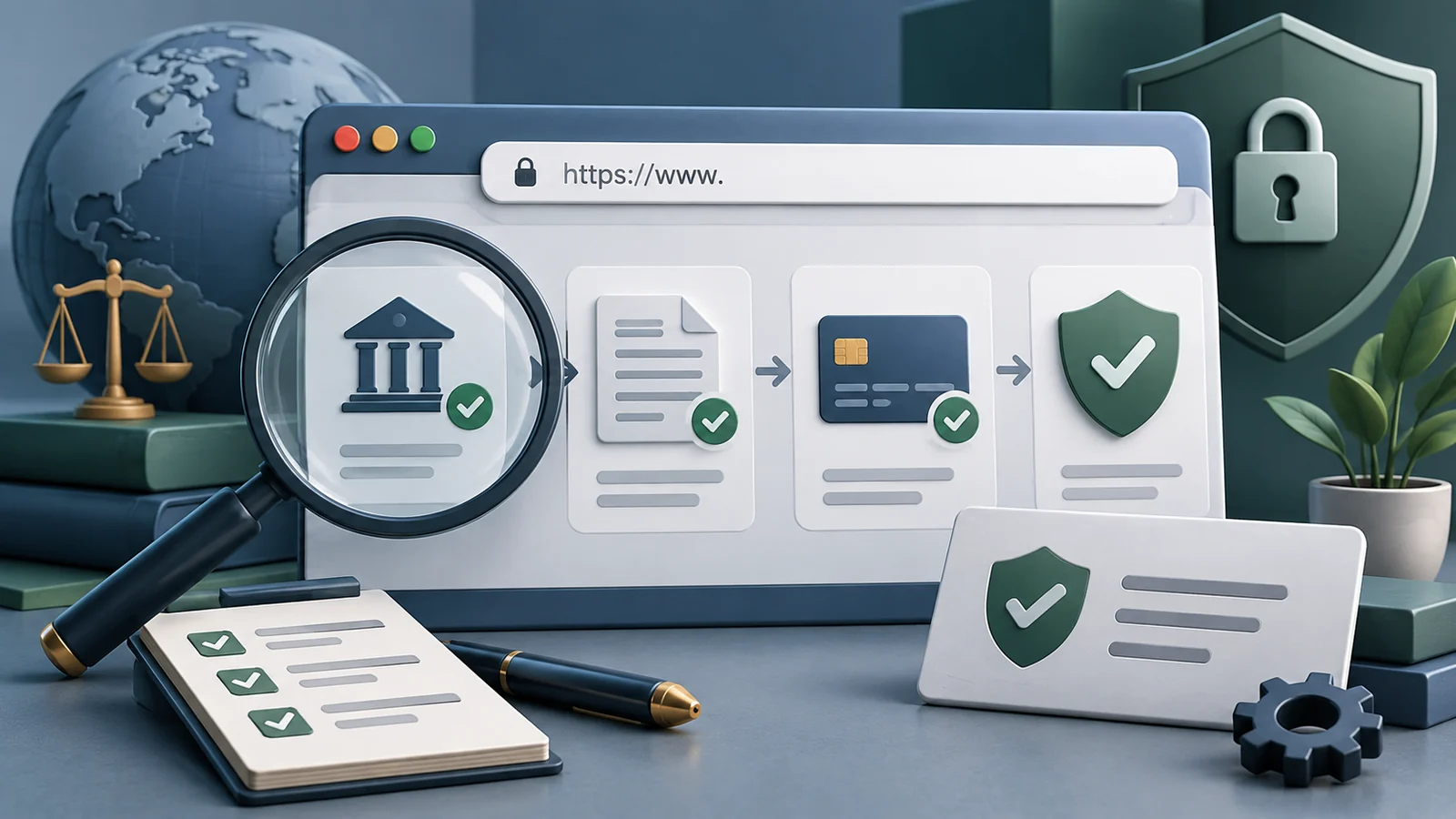
The safest way to evaluate an online casino is to verify what can be independently checked before you deposit. Start with the regulator and exact website domain, then review withdrawal terms, identity requirements, complaints information and responsible-gambling controls. A polished interface, influencer recommendation or copied licence logo is not a substitute for those checks.
Key takeaways
- Match the exact domain to a regulator record rather than trusting a footer badge.
- Read withdrawal and bonus terms before opting in, especially limits, verification conditions and restricted play.
- Confirm who owns and operates the site and how complaints can be escalated.
- Use only secure, official channels for KYC documents and payments.
- Treat unusually urgent bonuses, withdrawal workarounds or requests to bypass KYC as warning signs.
1. Verify the licence in the regulator’s own register
For a casino aimed at Great Britain, search the UK Gambling Commission’s public business register. Check the legal account name, licence status, activities and registered domain names. A brand can be operated by a company whose legal name looks different, so the critical point is whether the exact domain is listed under an active licence that covers remote casino activity.
If the site claims another jurisdiction, use that regulator’s own register rather than a screenshot supplied by the casino. Malta’s regulator, for example, provides a searchable licensee register and publishes enforcement information. Do not assume a licence from one jurisdiction automatically authorises the site where you live.
2. Check the domain, certificate and site identity
Look carefully for misspellings, extra hyphens, unusual subdomains or redirects that move you away from the address listed by the regulator. A valid HTTPS certificate is necessary for secure transport but is not proof of gambling authorisation. Phishing sites can also use HTTPS.
Confirm that the footer company details, terms, privacy notice and licence information are internally consistent. If the regulator lists one company and the site’s legal documents name another with no explanation, stop and verify the relationship before entering payment or identity data.
3. Read the withdrawal rules before the deposit rules
Marketing pages make depositing easy to understand; the withdrawal page is often more revealing. Check minimum withdrawal amounts, supported payout methods, verification requirements, pending or review stages and any stated fees. Be cautious with terms that appear to let the operator hold ordinary withdrawable funds without a clear reason.
For Great Britain, customers should not face unreasonable delays or restrictions on withdrawing their own money. Legitimate AML or security checks can still occur, so the question is whether the operator gives a specific, lawful reason and a route to resolve it. withdrawal processing stages explains the timing chain.
4. Inspect bonus conditions separately
A bonus can add restrictions that do not apply to a cash-only account. Check whether the promotion changes eligible games, maximum stake, withdrawal conditions, expiry or the treatment of bonus and cash balances. Significant conditions should be clear before you opt in.
If the promotional page relies on vague phrases such as “standard terms apply”, follow the link and locate the actual conditions before depositing. If you cannot explain the key rules in plain language after reading them, the offer is not a good basis for a deposit. The detailed wagering requirements guide covers turnover mechanics.
5. Understand KYC before sending documents
Regulated online gambling often requires age and identity verification. A legitimate operator may also need payment ownership or source-of-funds information in particular circumstances. Check which documents are accepted, how the upload portal works, how long the operator says it retains data and where its privacy notice is located.
Do not email passports or bank statements to an address found in a forum, chat message or social post. Start from the verified casino domain, sign in and use the secure account route. If support asks you to move the conversation to an unrelated messaging app, treat that as a security concern.
6. Find the complaints and dispute route
Before depositing, locate the complaints procedure. A UK-licensed operator should explain how to make a formal complaint and which approved Alternative Dispute Resolution provider can handle eligible disputes after the internal process reaches deadlock or the regulatory time limit.
Save the page or note the provider. This is not pessimism; it is the same due diligence you would apply to any paid service handling money. If a casino gives only a generic support form with no formal complaint path, investigate further before using it.
7. Check safer-gambling controls
Look for deposit or financial limits, time-outs, self-exclusion and access to help resources. The absence of visible controls is especially concerning when a site targets a regulated market that requires them. In Great Britain, self-exclusion obligations and GAMSTOP provide additional protection across licensed online operators.
Controls are useful only if you set them before emotions are driving decisions. A spending limit should be based on money that can be lost without affecting essentials. It should not be calculated from an expected win.
8. Review customer-funds and payment information
A casino should identify which payment methods it supports and disclose relevant fees or restrictions. In Great Britain, operators also have obligations to explain the level of protection applied to customer funds if the business becomes insolvent. Read the wording rather than assuming “licensed” means deposits are guaranteed like a bank account.
Use a payment method in your own name and keep transaction records. Avoid third-party payment arrangements offered by strangers or support agents; they can create both fraud and verification problems.
9. Treat pressure and workarounds as red flags
Walk away if you are told that a licence check is unnecessary, that verification can be bypassed, that you must deposit immediately to “unlock” a guaranteed return, or that a withdrawal problem will disappear if you make another payment. None of those claims is a normal substitute for documented terms and regulated processes.
Likewise, never install remote-access software or give a casino support agent control of your banking device. Security checks should verify information, not require you to surrender control of your computer or wallet.
10. Make the decision only after the checks agree
No single check proves that a casino is suitable for you. The conclusion comes from consistency: active licence, matching domain, clear ownership, fair terms, understandable payments, secure KYC, visible complaints process and workable safer-gambling tools.
If one material point cannot be verified, pause. The cost of leaving an uncertain site is zero; the cost of discovering the problem after a deposit can be much higher.
FAQ
Is a licence badge in the footer enough?
No. Verify the operator and exact domain in the regulator’s own register. Images and seals can be copied.
Does HTTPS mean the casino is licensed?
No. HTTPS encrypts traffic between your browser and the website. It does not establish gambling authorisation or fair terms.
Are KYC requests a red flag?
Not by themselves. Regulated operators commonly verify identity and age. The important checks are the reason, timing, secure submission channel and privacy information.
What if the casino has thousands of positive reviews?
Reviews can add context but should not replace licence, domain and terms checks. Use independently verifiable facts first.
Should I accept a bonus when opening an account?
Only if you understand and want the conditions. Declining a promotion can simplify withdrawals and account balances.
What is the fastest safety check?
Verify the exact domain in the relevant regulator’s public register. If that fails, do not deposit while you investigate.
Conclusion
A “safe casino” is not a logo or rating category. It is a set of verifiable conditions: lawful access in your location, a genuine active licence, a matching domain, fair terms, secure identity handling, transparent payments and a meaningful dispute process. Run those checks before money or documents leave your control.
Sources
- UK Gambling Commission — licence and domain verification
- UK Gambling Commission — consumer pre-gambling checks
- UK Gambling Commission — withdrawal rights and complaint route
- UK Gambling Commission — ADR escalation
- UK Gambling Commission — self-exclusion expectations
- Malta Gaming Authority — example of a second regulator’s public register
How this page was prepared
Reviewed by HolySlots Editorial Team. Claims, terminology, and time-sensitive details were checked against the sources listed below and the page was last updated September 15, 2026.
AI-assisted tools supported research organization or drafting; editorial review remained responsible for source selection and the published conclusions.