
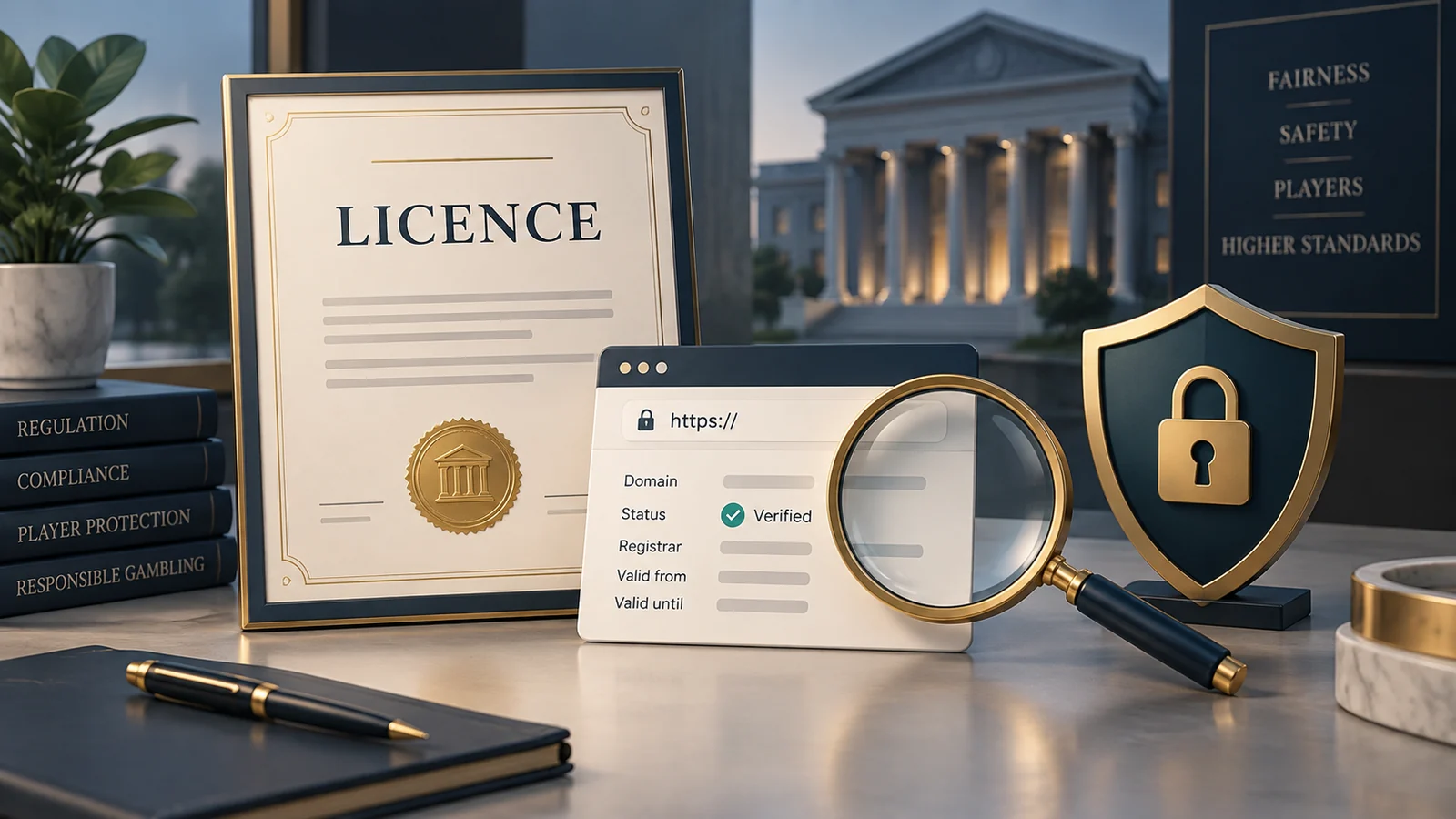
An online casino licence is permission from a regulator to conduct specified gambling activities under that regulator’s legal framework. It is not a universal passport. The licence can define which products an operator may offer, where it may serve customers and which rules apply to fairness, identity checks, complaints and player protection. The most important skill for a player is learning how to verify the licence against the exact website and jurisdiction rather than trusting the badge shown on the site.
Key takeaways
- A licence is jurisdiction-specific and activity-specific; it does not automatically authorise gambling everywhere.
- Verify the legal operator, trading name, domain, licence status and permitted activities in the regulator’s own register.
- Regulators differ in law, complaints systems, technical standards and enforcement powers.
- A licence is evidence of regulatory oversight, not a guarantee that every customer dispute will be decided in the player’s favour.
- If a site targets Great Britain, another country’s licence does not replace the need for the relevant UKGC licence.
What a casino licence is designed to do
Licensing gives a regulator a legal relationship with the gambling business. The operator normally has to satisfy entry requirements and then continue to meet licence conditions. Depending on the jurisdiction, those conditions can cover ownership, financial suitability, anti-money-laundering controls, age verification, game fairness, marketing, customer funds, complaints and responsible-gambling measures.
The licence therefore creates enforceable obligations that an unlicensed website may not accept. It also gives players an external reference point: a public register, published rules and, often, regulatory or dispute routes. But the exact protections depend on the law behind the licence. “Licensed” without naming the regulator and licence status tells you very little.
Why jurisdiction changes the meaning of the licence
Gambling law is territorial. A regulator acts under the authority given to it by its own legislation, and a licence normally governs activity connected to that territory or specified customers. That is why a site can be lawful for one market and unavailable or unlawful in another.
Great Britain provides a clear example. The UK Gambling Commission states that an operator needs its licence to provide remote gambling to consumers in Great Britain regardless of where the business is based. A Malta licence may be relevant to activities regulated by the MGA, but it does not itself authorise serving British consumers. how to check whether online casino gambling is legal where you are gives a location-first method.
What regulators commonly oversee
Although the details vary, regulators may supervise whether the operator offers only authorised products, verifies customers, protects minors, applies anti-money-laundering controls, handles complaints, follows technical standards and meets rules on safer gambling or advertising. Technical oversight can include independent testing of RNG-driven games and the software used to map random inputs to outcomes.
That does not mean the regulator approves every individual promotion or every customer decision before it happens. Regulation is a framework of rules, monitoring, reporting, audits and enforcement. Players still need to read the specific game and account terms.
How to verify a UK licence step by step
Start at the UK Gambling Commission public register, not from a search-engine advert. Search the brand, business or domain. Open the licence record and confirm that the status is active, that remote casino activity is included when you are checking an online casino, and that the domain you intend to use appears under the operator.
Then compare the legal name and account information with the casino’s footer and terms. Check the register for regulatory actions if relevant. A mismatch does not always prove fraud—group structures and white-label arrangements can be complex—but it is a reason to stop and understand the relationship before depositing.
How to verify a licence in another jurisdiction
Use the same logic but the regulator’s own tools. Find the authority’s official website, open its licensee register, search the operator and domain, and check the current status and authorised services. The Malta Gaming Authority, for example, provides a licensee register and enforcement register and has warned about unauthorised websites impersonating licensed operators.
Do not rely on a licence number pasted into a casino footer unless the regulator confirms it. Avoid third-party “licence checker” pages when the primary register is available. If the regulator does not publish enough information to verify the claim, record that limitation rather than guessing.
What a licence does not guarantee
A licence does not guarantee that you will win, that every withdrawal will be instant, or that the operator can never make an error. It also does not turn bonus credit into cash or eliminate contractual conditions. Regulators can require fair processes and take enforcement action, but individual disputes may still have to go through the operator and an ADR provider or court route.
Nor does a licence protect against ordinary gambling losses. Game maths still applies. A regulated slot can produce a long losing sequence; a regulated roulette wheel still has a house edge. Licensing is about lawful and fair operation, not favourable outcomes.
Licence red flags
Red flags include a badge that cannot be clicked or matched to a public record, a domain absent from the regulator’s listing, an expired or suspended status, legal terms naming a different operator without explanation, or support staff telling you that regulation “does not matter” because payments use cryptocurrency.
Another warning sign is a site that advertises access to a market while claiming that an unrelated offshore licence makes local rules irrelevant. A regulator’s authority is defined by law, not by the payment method or server location.
Licensing and verification are connected but different
Licensing concerns the operator; KYC concerns the customer. A licensed operator may be required to verify your age and identity, and regulated casinos may also conduct financial checks where law and risk require them. Those requests should still be proportionate, secure and explained.
If a website advertises “no verification” as a way to avoid legal restrictions, that is not a stronger form of privacy. It can be a sign that the operator is not following the framework that would normally protect the customer. casino KYC explained covers what legitimate verification looks like.
A practical hierarchy for licence claims
Treat the regulator’s live register as the strongest public evidence, followed by official enforcement notices and legislation or licence conditions. The operator’s own footer and terms are useful for comparison but are not independent verification. Reviews, forums and social media can surface issues but sit lower in the evidence chain.
This hierarchy keeps the task simple: verify the authority first, then use third-party information to investigate context rather than to establish whether the licence exists.
FAQ
Does an offshore licence make an online casino legal in the UK?
No. To provide remote gambling to consumers in Great Britain, the operator needs the relevant UK Gambling Commission licence. A foreign licence does not replace it.
Can one casino have more than one licence?
Yes. Operators or group companies can hold authorisations in multiple jurisdictions. Each licence should be checked separately against the market and legal entity involved.
What if the brand name is not the same as the company name?
That is common. Verify that the brand or trading name and exact domain are connected to the licensed legal entity in the regulator’s records.
Does a licence guarantee my withdrawal?
No. It provides a regulatory framework and consumer rules, but individual withdrawals can still involve checks or disputes. Use the formal complaint process if a licensed operator does not resolve an issue.
Are casino games tested by regulators themselves?
Not always. Regulators may require independent approved test houses and specified testing procedures, with reports supplied to the regulator or retained for compliance.
How often should I re-check a licence?
At minimum, when opening an account and whenever the domain, operator or legal terms change. For high-value use, checking before a significant deposit is sensible because licence status can change.
Conclusion
The useful question is not “is this casino licensed?” but “licensed by whom, for which activity, for which market, under which legal entity, and is this exact domain currently covered?” Answering those points from primary records turns a vague trust claim into something you can actually verify.
Sources
- UK Gambling Commission — GB public licence and domain verification
- UK Gambling Commission — scope of remote casino operating licence
- UK Gambling Commission — foreign licence does not authorise service to Great Britain
- Malta Gaming Authority — MGA register and enforcement example
- UK Gambling Commission — independent game and RNG testing framework
How this page was prepared
Reviewed by HolySlots Editorial Team. Claims, terminology, and time-sensitive details were checked against the sources listed below and the page was last updated September 15, 2026.
AI-assisted tools supported research organization or drafting; editorial review remained responsible for source selection and the published conclusions.